
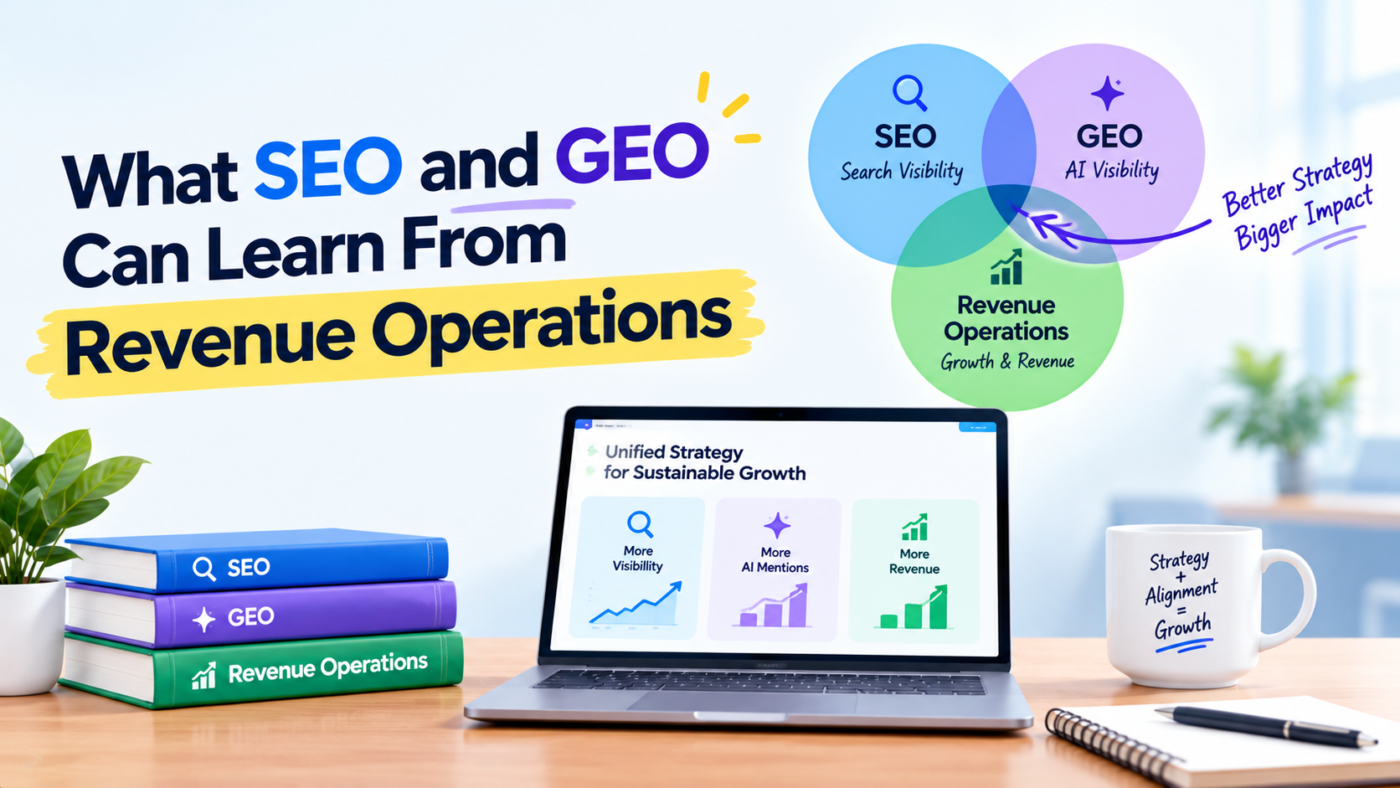
If you work in SEO or GEO, you’ve probably celebrated a traffic spike or a jump in AI citations. But here’s a question worth asking: did that spike actually make money?
That’s where revenue operations (RevOps) comes in. RevOps teams don’t just count activity — they connect every effort to revenue. And SEO and GEO teams can borrow the same approach.
Let’s break down what that looks like, in plain language.
Traffic Doesn’t Always Equal Money
Most SEO reporting leans on rankings, impressions, clicks, and share of voice. GEO adds citations, mentions, and AI visibility to the mix. These are useful numbers, but they’re not proof of commercial value.
Consider this: a page with 10,000 visits might bring in fewer real opportunities than a page with 500 visits. Why? Because intent matters more than volume.
A real example: at a healthcare publication, one page targeted a keyword with zero reported monthly search volume in the U.S. It got very few clicks compared to other pages. But because the people who did click were ready to act, that page generated over $40,000 in annual revenue — nearly double the next best page.
The same logic applies to GEO. Being cited in AI answers feels great, but if those citations never lead to a decision that matters commercially, the value is questionable.
The takeaway: measure commercial impact first. Visibility is just a means to that end.
Start With Clear Funnel Definitions
RevOps teams share common definitions for how a customer moves from stranger to buyer. The typical stages look like this:
Prospect
Marketing-qualified lead (MQL)
Sales-qualified lead (SQL)
Opportunity
Closed-won or closed-lost
Your SEO and GEO work should be mapped to the stages it can realistically influence:
An informational article may build awareness and push people toward product research.
A high-intent comparison page may generate demo requests.
A brand mention or AI citation may shape a decision long before someone visits your site — or even a month after the last touchpoint.
Think in reverse: start from the outcome you want, then work out which touchpoints should move people toward it. Not every piece of content needs to convert right away.
Measure Conversion Between Stages
Total traffic and citation growth tell you about visibility. Stage-to-stage conversion rates tell you about quality.
SEO produced twice as many SQLs — but needed 10 times the traffic to do it.
AI referrals had a much higher qualification rate.
But you still can’t declare a winner without knowing revenue, cost, and deal size.
Take it one step further. Say both channels convert 25% of SQLs into customers:
SEO: 10 customers at $10,000 each = $100,000 in revenue
AI referrals: 5 customers at $30,000 each = $150,000 in revenue
Same number of SQLs? No. But AI referrals brought in 50% more revenue with half the SQLs. (This is just an illustration — your numbers will depend on your business.)
Borrow Lead Scoring and Qualification
Not every conversion is valuable. That’s why RevOps uses lead qualification and scoring to separate real opportunity from surface-level activity.
Things like company size, industry, location, buying authority, and meaningful actions (comparing products, engaging with key pages, booking demos) all help build a picture of genuine buying intent.
Apply the same thinking to SEO and GEO. Ask: which topics and landing pages consistently attract leads that actually move through the sales process?
Compare two pages:
An educational page: 10,000 visits, 300 newsletter signups
A niche integration page: 50 visits, 8 booked demos
If those newsletter subscribers rarely become high-value customers, the integration page may deserve more resources — even though it looks like nothing on a traditional traffic dashboard. Especially if those demos are a great fit for your ideal customer profile (ICP).
Connect Everything to Unit Economics
Once you accept that traffic alone isn’t the goal, prioritization becomes a resource allocation question. You need to weigh:
Cost per MQL and SQL
Cost per opportunity and closed-won customer
Customer acquisition cost (CAC) vs. lifetime value (LTV)
Expected pipeline value and revenue
Velocity (how fast leads move through the funnel)
If you can connect your traffic sources to CRM records and revenue, you can compare channels fairly.
Example: a content initiative costs $15,000. Based on past performance, you expect 20 SQLs and 3 closed-won customers at $10,000 average order value.
Potential revenue: $30,000
Gross profit at 70% margin: $21,000
After the $15,000 investment: $6,000 left before other expenses
That might look good — but the decision still depends on how likely those results are, how long they’ll take, and whether a better option exists.
When Attribution Gets Messy, Work Backward
Perfect attribution isn’t always possible. Complex buyer journeys, multiple touchpoints, offline influence — it gets complicated. But that doesn’t mean you stop measuring.
Use different levels of confidence:
Direct attribution — when analytics cleanly connect the dots. This is the ideal scenario.
Estimated value — when leads exist but no customers have closed yet. For example: SEO generates 20 SQLs, historical close rate is 20%, average customer value is $10,000. Expected revenue: $40,000. It’s not realized revenue, but it’s a solid baseline.
Directional indicators — things like AI citations and high-intent brand searches with no identifiable leads. These suggest possible commercial influence, but they can’t prove direct revenue contribution on their own.
If your work involves a mix of all three, measure what you can and use those learnings to fill in the gray areas. When testing channel tactics, evaluate through cohorts or user journeys to see whether demand is actually moving.
It won’t be perfect — but you’ll have a direction to base decisions on.
Build a Rhythm Around Funnel Movement
SEO, GEO, and RevOps shouldn’t operate in silos. They should work together, focusing visibility efforts on the surfaces that drive the most funnel movement.
Set clear expectations across the organization:
Who owns what
When results will be reviewed
What thresholds determine whether to continue, pivot, or reallocate budget
Celebrate wins when targets are exceeded. Pull back when they’re not.
Rankings, traffic, and AI citations are still useful signals. But they’re no substitute for understanding the economics of customer acquisition.
The Bottom Line
The biggest opportunity for SEO and GEO teams is to borrow RevOps discipline — applying commercial context before users are even acquired. That means:
Defining funnel stages clearly
Tracking conversion between stages
Scoring leads for real intent
Connecting everything to revenue and cost
Measuring with the right level of confidence
When SEO and GEO speak the same language as revenue operations, they stop being cost centers and start being growth engines.