
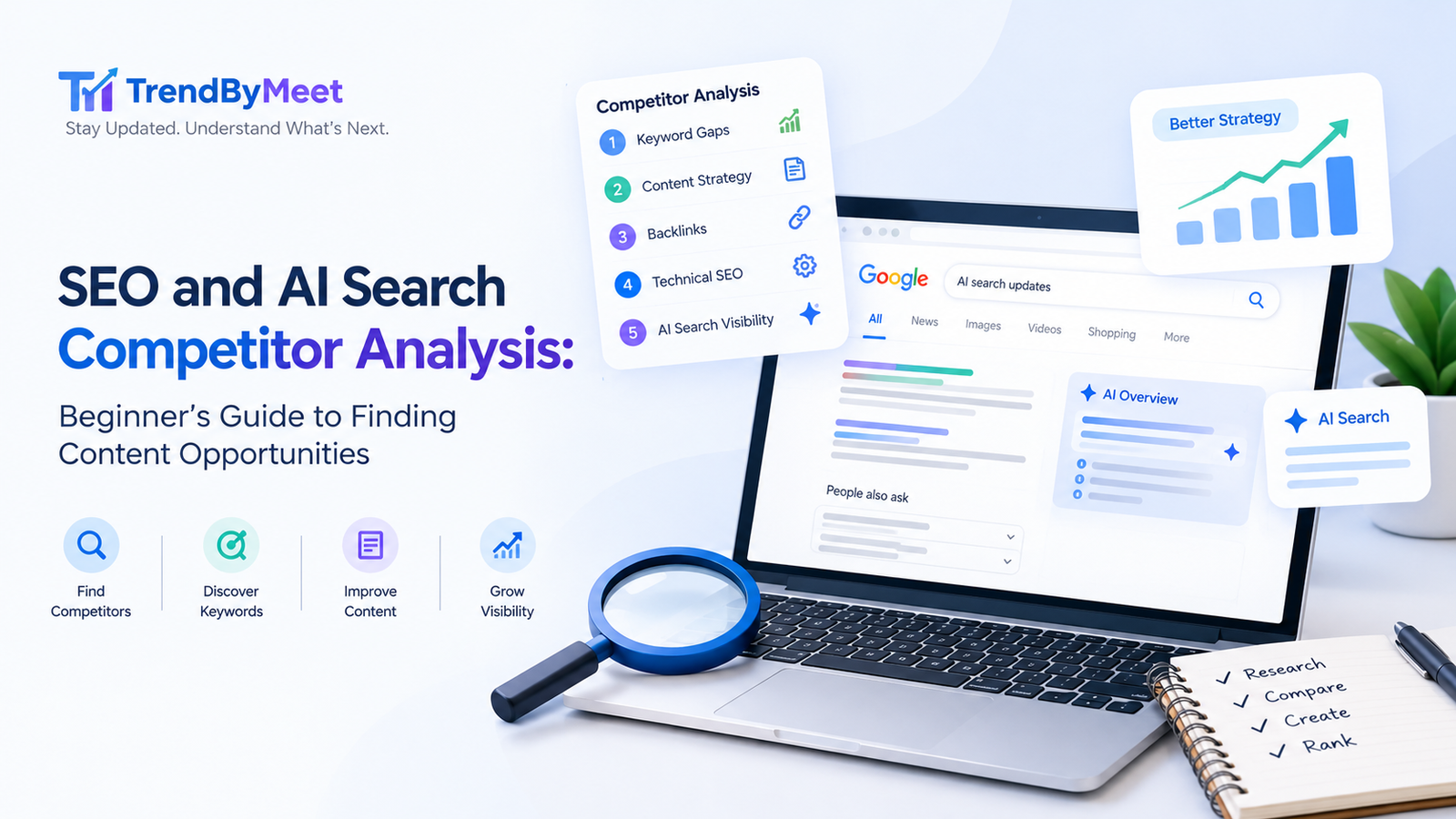
Have you ever wondered why some websites appear on the first page of Google while others struggle to get noticed?
One reason could be their SEO strategy. Successful websites often understand what their competitors are publishing, which keywords they target, and how they make their content useful for readers.
This is where SEO competitor analysis becomes important.
Competitor analysis helps you understand what other websites are doing well and discover opportunities to improve your own website. Today, it is also useful to understand how websites appear in AI-powered search experiences, including Google AI Overviews and AI assistants.
In this guide, we will explain what SEO competitor analysis is, why it matters, and how beginners can start using it to improve their websites.
What Is SEO Competitor Analysis?
SEO competitor analysis is the process of studying other websites that appear in search results for the topics you want to cover.
The goal is not to copy their content. Instead, it is to understand their strengths, identify missing information, and create something more helpful for your audience.
For example, imagine you run a website that publishes AI news and updates.
You want to write an article about Google AI Overviews. You search for this topic on Google and find several websites covering it.
You can study those articles to understand:
- Which questions do they answer?
- What information have they included?
- Are their explanations easy to understand?
- What important details are missing?
- How can your article provide more value?
These observations can help you plan a stronger article for your own website.
Why Is Competitor Analysis Important for SEO and AI Search?
Competitor analysis can help you make better content decisions instead of choosing topics randomly.
Here are four important benefits.
1. Discover New Content Ideas
Your competitors may be covering useful topics that you have not published yet.
For example, if other AI news websites are publishing beginner-friendly guides about AI search, you may discover related topics such as:
- What Is Google AI Overviews?
- How Does AI Search Work?
- How Is AI Search Different From Traditional Search?
- What Does AI Search Mean for Website Owners?
You can use these ideas to build a relevant content plan.
2. Find Keyword Opportunities
Keywords are the words and phrases people type into search engines.
Competitor analysis can reveal keywords that other websites rank for but your website does not target yet. These are often called keyword gaps.
You can review these opportunities and decide whether to improve an existing article or create a new one.
Remember, not every keyword will be relevant to your website. Focus on topics that match your audience and the purpose of your site.
3. Improve Your Content Quality
Studying competing articles can help you identify ways to make your own content more useful.
You might discover that readers need clearer explanations, practical examples, updated information, or answers to common questions.
Your aim should be to provide accurate, original and helpful information—not simply to write a longer article.
4. Understand Your Visibility in AI Search
People increasingly use AI-powered experiences to find information and get answers.
Competitor analysis can help you investigate whether your website or brand is mentioned in relevant AI-generated answers and compare that visibility with other websites.
However, appearing in AI-generated answers is not guaranteed, even when your website follows good SEO practices.
SEO Competitors vs. Business Competitors: What Is the Difference?
Your SEO competitors are not always the same as your business competitors.
Business competitors offer similar products or services to the same customers.
SEO competitors are websites competing for visibility on the same search queries.
For example, TrendByMeet publishes AI updates and beginner-friendly explanations. When targeting a topic such as Google AI Overviews, its search competitors might include technology news websites, SEO blogs, and educational websites.
These sites may not have the same business model, but they compete for readers searching for similar information.
This is why it is important to identify competitors topic by topic rather than assuming that every website in your niche is a direct competitor.
How to Conduct SEO and AI Search Competitor Analysis
You do not need expensive tools to begin. Follow these practical steps to understand your competitors and find content opportunities.
Step 1: Find Your SEO Competitors
Start by searching for the topics you want your website to rank for.
For example, if you publish AI updates, try searching:
- Google AI Overviews explained
- Latest AI updates
- How AI search works
- AI news for beginners
Open the results and note the websites that repeatedly appear for relevant searches.
Create a simple Google Sheet with these columns:
| Competitor website | Topic | What to study |
|---|---|---|
| Website A | Google AI Overviews | Article structure |
| Website B | AI search | Beginner-friendly explanations |
| Website C | AI updates | Content freshness |
These are example labels for your research sheet, not verified competitor rankings.
Beginner tip: Start with three relevant websites. You do not need to analyze dozens of competitors at once.
Step 2: Identify Keyword Gaps
Once you have identified your competitors, look for relevant keywords that they cover but your website does not.
For example, you may already have an article about Google AI Overviews but have not explained how AI-generated answers could affect website visibility.
That missing topic could become an opportunity for a new article or an additional section in your existing content.
Tools such as Google Search Console can help you understand the search queries for which your own website receives impressions and clicks. Tools such as Semrush offer competitor keyword comparison features, although some features require a paid plan.
When selecting keywords, consider three things:
- Relevance: Does the topic match your website?
- Search intent: What information does the reader want?
- Content opportunity: Can you create a useful article that answers the question well?
Do not target a keyword just because a competitor ranks for it.
Step 3: Analyze Your Competitors’ Content
Open a few competing articles and study how they explain the topic.
Pay attention to the following:
Content structure: Do they use clear headings, short paragraphs, lists, and examples?
Accuracy: Is the information supported by reliable sources?
Freshness: Does the article include outdated information that needs updating?
Readability: Can a beginner understand the explanation without specialized knowledge?
Missing information: Are there questions that the article does not answer properly?
For example, if a competing article uses technical SEO terminology without explaining it, you could make your own article more beginner-friendly by defining each important term and including a simple example.
The objective is to improve the reader’s experience, not to imitate another website’s writing style.
Step 4: Review Titles, Headings, and URLs
A well-structured article helps readers understand what they are about to read and makes the page easier to navigate.
Review how competitors use their page titles, headings, and URLs.
For example:
- Article title: How Google AI Overviews Work
- URL:
example.com/google-ai-overviews - Main heading: What Are Google AI Overviews?
- Subheadings: How They Work, Benefits, Limitations, and SEO Impact
For your own website, use a clear title that accurately describes the article. Keep URLs short and meaningful, and organize the content using a logical heading hierarchy.
A good structure improves readability, but it does not guarantee a higher search ranking.
Step 5: Check Backlinks
A backlink is a link from another website to your website.
Relevant backlinks from trustworthy websites can help search engines discover pages and may contribute to a site’s search performance.
During competitor analysis, examine which websites link to competing articles and why those links exist.
For example, a technology publication might link to a detailed guide because it explains a complicated AI update clearly.
You can use this insight to create useful resources of your own, such as original explainers, research summaries, or practical guides.
Avoid buying spammy links or creating irrelevant links simply to manipulate rankings. Focus on earning links by publishing genuinely valuable content.
Step 6: Check Website Speed and Technical SEO
Good content matters, but visitors also need a website that works properly.
Review your website for issues such as:
- Slow-loading pages
- Poor mobile usability
- Broken links
- Confusing URLs
- Missing or duplicated page titles
- Incorrect indexing settings
Google’s free PageSpeed Insights tool can help you assess page performance and Core Web Vitals.
For a WordPress website like TrendByMeet, also check that your featured images are optimized, your theme displays well on mobile devices, and important articles can be accessed through sensible navigation and internal links.
You do not need to fix every technical issue at once. Start with problems that prevent readers or search engines from accessing your content properly.
Step 7: Compare Your Visibility in AI Search
Traditional SEO analysis focuses heavily on search engine results. AI search analysis also looks at whether websites or brands appear in AI-generated responses.
You can start with a simple manual review.
Try asking relevant questions in AI search experiences, such as:
- What are the latest developments in AI search?
- How do Google AI Overviews affect SEO?
- Which websites explain AI updates for beginners?
Check whether your website is mentioned and which sources are cited.
Repeat the process for a few relevant questions and record your observations. AI answers can vary, so one response is not enough to establish a reliable trend.
Some SEO platforms provide dedicated AI visibility reports, but access may depend on the tool and subscription.
Important: There is no guaranteed formula for getting a website mentioned by an AI system. Clear, accurate, original content and a technically accessible website are sensible foundations, but results can vary.
Best Free Tools for Beginner-Friendly Competitor Analysis
You can start with these tools without immediately purchasing an SEO subscription.
| Tool | How it helps |
|---|---|
| Google Search | Find websites competing for your target topics |
| Google Search Console | Review your site’s search queries, impressions, and clicks |
| Google Trends | Explore interest in topics over time |
| Google PageSpeed Insights | Check page performance and Core Web Vitals |
| Google Sheets | Record competitors, keywords, and content ideas |
Paid platforms such as Semrush and Ahrefs offer more advanced keyword, backlink, and competitor research features.
For a new website, begin with the free tools and invest in paid tools only when you have a clear reason to use their additional features.
A Simple Competitor Analysis Example for TrendByMeet
Let’s say TrendByMeet wants to publish a helpful article about AI search and SEO.
You could follow this basic plan:
Step 1: Search Google for “Google AI Overviews explained.”
Step 2: Record three relevant websites that appear in the results.
Step 3: Review their articles and note the main questions they answer.
Step 4: Identify missing explanations that would help beginners.
Step 5: Write an original article using clear headings, reliable references, and practical examples.
Step 6: Publish the article with a descriptive title, a relevant URL, and a suitable featured image.
Step 7: Monitor its impressions and clicks in Google Search Console after Google has had time to discover and index it.
This process helps you make content decisions based on research instead of guessing what readers might want.
Common Competitor Analysis Mistakes to Avoid
When starting SEO research, avoid these common mistakes:
- Copying competitors: Learn from their approach, but write original content.
- Targeting every keyword: Choose topics that are relevant to your readers.
- Ignoring search intent: Make sure your article answers the question people are actually asking.
- Focusing only on word count: Longer content is not automatically better content.
- Ignoring technical problems: A useful article still needs to be accessible and usable.
- Expecting instant results: Search visibilty takes time and depends on many factors.
- Treating AI visibility as guaranteed: AI-generated answers can change, and inclusion is not assured.
A successful strategy combines useful content, sound technical practices, and regular performance reviews.