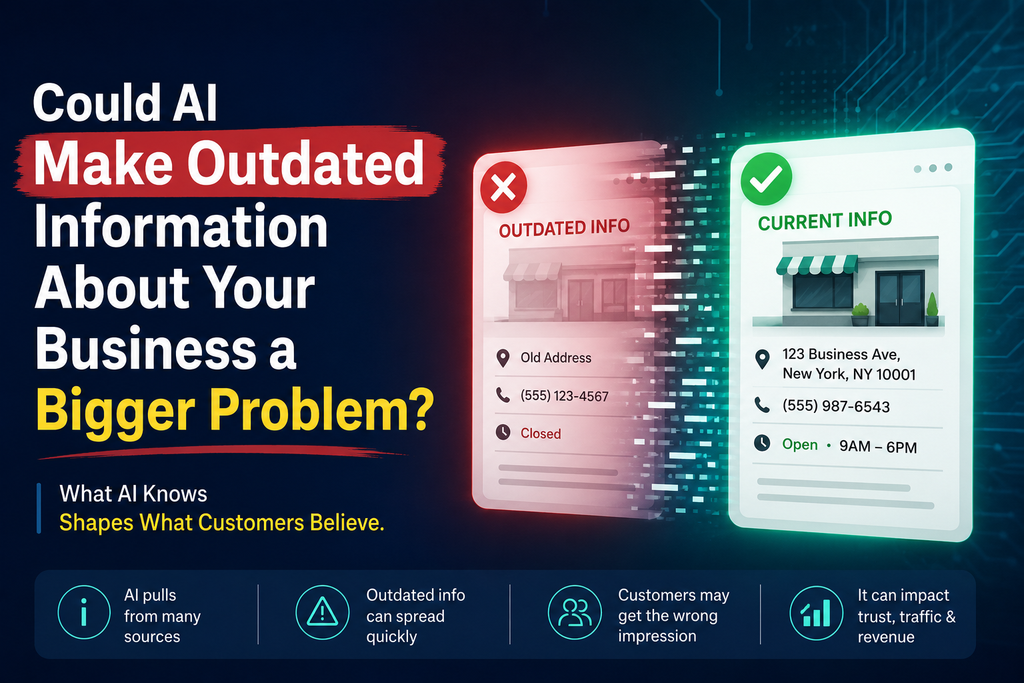
AI search can use information from across the web. Learn how outdated business information could affect AI answers and why this may create a new challenge for businesses.
Imagine you changed your business completely.
Three years ago, your company offered web development. Today, you focus on AI automation.
You update your website, LinkedIn page and social media.
But dozens of old websites still describe your company as a web development agency.
Now someone asks an AI:
“What does this company do?”
The AI may use information from different websites—not just your homepage.
And that’s where things get interesting.
AI Doesn’t Only See Your Website
When AI-powered search systems answer questions, they can use information from articles, business directories, interviews, profiles and other websites.
That means your online identity isn’t controlled by your website alone.
Old information across the internet can still exist even after your business has changed.
Research into AI search has also found that the sources appearing in AI-generated answers can change over time, making online visibility more dynamic than traditional search.
So What’s the “AI Money Grab”?
This is the interesting prediction made in a recent Search Engine Land article.
As businesses become more concerned about how AI describes them, they may start checking websites that mention their company.
They could find hundreds of outdated references and contact publishers asking them to update the information.
That creates a possible business opportunity:
What if publishers start charging companies to make those corrections?
For example, a publisher could potentially offer a paid service to update old company descriptions or maintain business profiles.
That’s the “AI money grab” the article is talking about.
But there’s an important catch.
This is a prediction—not an established fact.
The Search Engine Land article does not prove that publishers are already broadly charging businesses for AI-related corrections.
It’s suggesting that this could become a future business model as AI visibility becomes more valuable.
But Should Every Old Article Be Changed?
Absolutely not.
There’s a big difference between incorrect information and old information.
For example:
If an article incorrectly says someone is the CEO when they left the company years ago, correcting it makes sense.
But if an article accurately reports that a company failed with a product in 2019, the company shouldn’t be able to pay a publisher to erase that history simply because it no longer looks good.
Correction and reputation management are not the same thing.
That distinction becomes especially important if AI visibility becomes a major part of digital marketing.
What Does This Mean for Businesses?
You don’t need to panic or start paying websites to change everything.
Instead:
1. Keep your own information accurate.
Update your website, company profiles, author bios and social accounts.
2. Monitor important third-party mentions.
Search your brand name and see what major websites are saying about you.
3. Correct genuine mistakes.
If a website contains factually incorrect information, contact the publisher.
4. Don’t try to erase your history.
An old article isn’t automatically wrong just because your business has changed.
5. Think beyond traditional SEO.
Your website rankings aren’t the only thing that matters anymore. How your brand is represented across the wider web can also influence how people—and potentially AI systems—understand your business.
The Bigger Picture
For years, businesses focused on:
Google rankings → Website traffic → Clicks → Customers
AI search is adding another layer:
AI visibility → Mentions → Citations → Brand representation
That’s why the discussion around outdated information is becoming more interesting.
AI search is changing how people discover information, while publishers are also dealing with questions around attribution and traffic. Research has already highlighted concerns about how AI systems use and attribute web content.
But whether publishers actually turn editorial corrections into a widespread paid service is still unknown.
The Bottom Line
The important lesson isn’t that publishers are already charging companies to fix AI information.
They’re not—at least this article doesn’t prove that.
The real issue is that your online identity exists across the entire web.
Your website is only one piece of that picture.
As AI search becomes more important, businesses may pay much more attention to what old articles, profiles and third-party websites say about them.
And that could eventually create a new market around managing information used by AI.
For now, the smartest approach is simple: keep the information you control accurate, monitor important third-party mentions, and correct genuine mistakes without trying to rewrite history.